How big is the Moon, in countries?
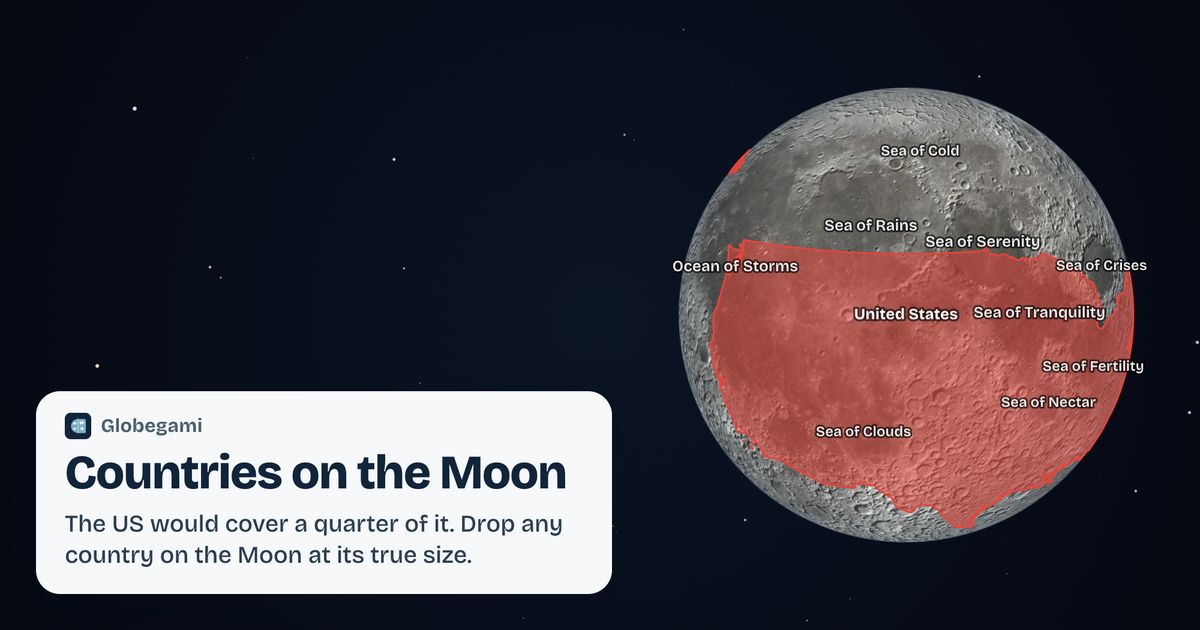
Smaller than most people think. The Moon's entire surface, near side and far side together, is about 37.9 million km². That is roughly Africa and Australia put together, and less than Asia.
By the Globegami team · 24 November 2026
The basic numbers
- Width: 3,474 km, a little over a quarter of Earth's (12,742 km). The 48 contiguous United States, about 4,500 km from coast to coast, are wider than the Moon. So is Australia.
- Surface: 37.9 million km², about 7.4% of Earth's surface and about a quarter of Earth's land.
- Volume: about one fiftieth of Earth's. Fifty Moons would fit inside the Earth.
- Mass and gravity: the Moon has about 1/81 of Earth's mass, and gravity at its surface is one sixth of ours.
- Distance: 384,400 km on average, about thirty Earths side by side. Light takes 1.3 seconds to cross it.
Countries on the Moon
If you could lay a country on the Moon without changing its real area, this is how much of the whole surface each of the ten largest would cover:
| Country | True area | Share of the Moon |
|---|---|---|
| Russia | 17,098,246 km² | 45% |
| Canada | 9,984,670 km² | 26% |
| United States | 9,826,675 km² | 26% |
| China | 9,596,961 km² | 25% |
| Brazil | 8,515,767 km² | 22% |
| Australia | 7,692,024 km² | 20% |
| India | 3,287,263 km² | 8.7% |
| Argentina | 2,780,400 km² | 7.3% |
| Kazakhstan | 2,724,900 km² | 7.2% |
| Algeria | 2,381,741 km² | 6.3% |
Russia alone would wrap around nearly half of it. The ten together add up to nearly twice the Moon's whole surface. The full list of countries on the Moon has every country over 100,000 km².
Why it looks bigger than it is
In the sky the Moon is only about half a degree wide. Hold a finger out at arm's length and the tip of your little finger covers it. It seems enormous near the horizon, but that is a trick of perception known as the Moon illusion: measure it and it is the same size as when it is overhead.
Pictures don't help. Diagrams nearly always draw the Moon close to the Earth, because at true scale the gap is so wide that both shrink to dots. Globegami's Earth-and-Moon view can switch to the true distance to show it.
See the Earth and Moon →Two different faces
The Moon turns once for every trip around the Earth, so we always see the same side. The dark patches on that side are the “seas”: plains of old lava, named when people thought they were water. They cover nearly a third of the near side and almost none of the far side, which is paler and more heavily cratered. Nobody had seen the far side until a Soviet probe photographed it in 1959.
All six Apollo landings, between 1969 and 1972, were on the near side, where the crews could talk to Earth directly. Twelve people have walked on the Moon. Their landing sites, with NASA's photographs, are marked on Globegami's Moon.
What if you flooded it?
The Moon's lowest ground is the South Pole–Aitken basin on the far side, an impact scar about 2,500 km across and one of the largest known in the solar system. Pour a small sea onto the Moon and that is where it would collect.
Pour all of Earth's water onto it, about 1.39 billion cubic kilometres, and the Moon would be covered roughly 37 km deep, with its highest mountain far below the surface. (Real water wouldn't stay: with no air and weak gravity it would boil away into space.) You can try it with any ocean, sea or lake.
Flood the Moon →More to read
Areas: official totals including inland water (UN Statistics Division via Wikidata). Population: World Bank 2024 (CC BY 4.0), else Wikidata. Income and children per woman: World Bank. 2100: UN World Population Prospects 2024, medium projection. Height: NCD-RisC. Urban areas: GHSL Urban Centre Database 2025 (European Commission, JRC), built-up area rather than city limits. Past positions: Matthews et al. 2016. Outlines: Natural Earth. Borders and disputed areas are shown as the Natural Earth dataset draws them; Globegami takes no position on them.
How Globegami works · Articles · Every country's true size · For teachers · Privacy · Terms · Contact